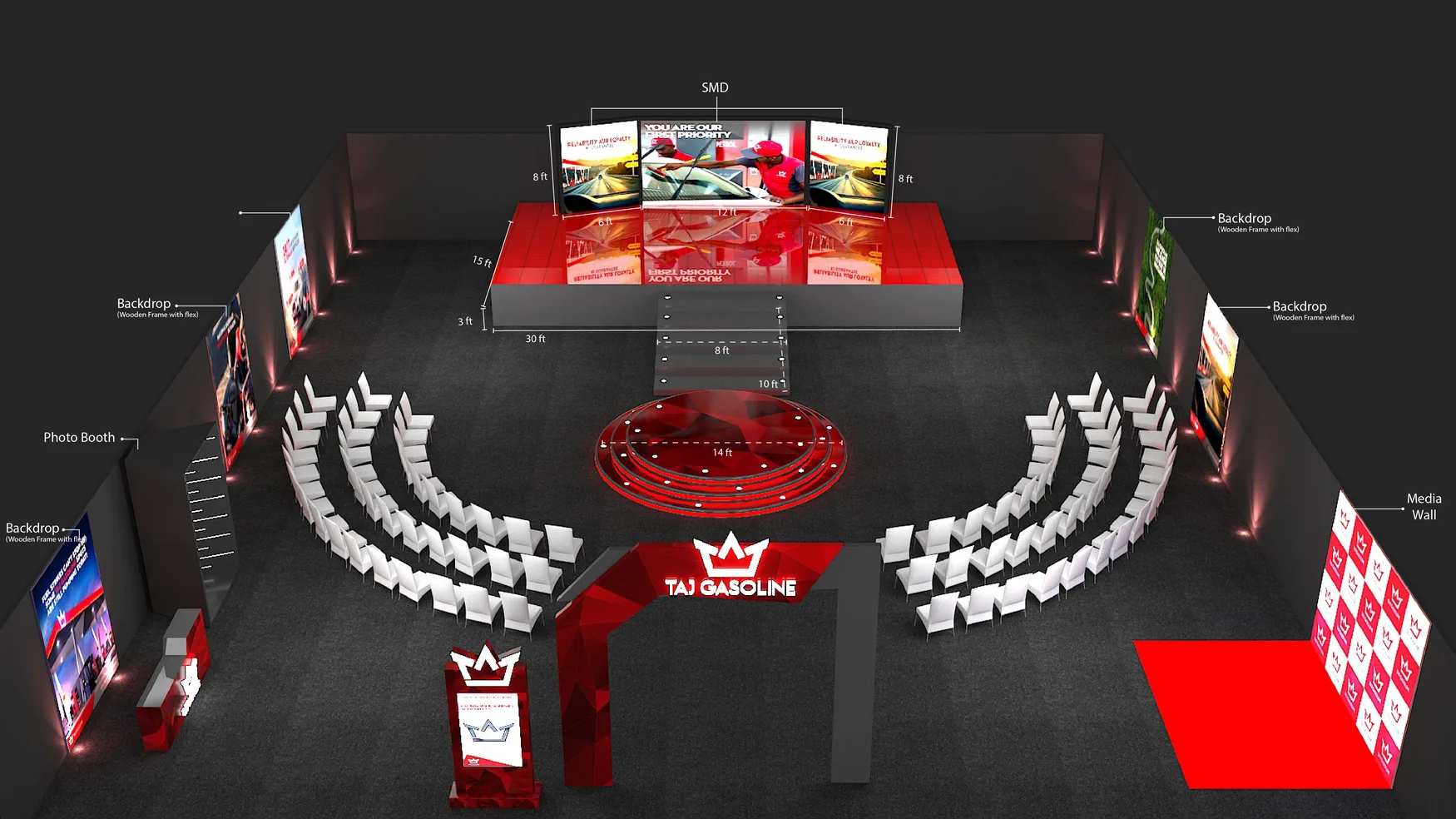
A successful event concept should explain how people move, where the brand appears and what experiences take place. The render is a way to test those choices before the production team acts.
Project visuals from Hamza Shah’s supplied portfolio. The editorial text is general design guidance, not a construction specification.
Start with the real constraints
Start with the purpose of the event: a launch, presentation, demonstration or visitor engagement. Each suggests a different spatial hierarchy.
Make the visitor experience legible
Identify key moments such as entry, reveal, main stage, interactive zone and exit, then connect them with intuitive paths.
Coordinate the details
Use 3D perspectives to review camera sightlines, graphic placement and crowd gathering areas.
Review the handoff and responsibilities
Separate creative visualization from rigging, structural, fire and venue approvals, which require qualified production review.
How to apply these ideas
Identify key moments such as entry, reveal, main stage, interactive zone and exit, then connect them with intuitive paths. Separate creative visualization from rigging, structural, fire and venue approvals, which require qualified production review.
Production, engineering, permissions and safety require review by the relevant qualified local parties.
Frequently asked questions
What is the first practical step?
Start with the purpose of the event: a launch, presentation, demonstration or visitor engagement. Each suggests a different spatial hierarchy. Identify key moments such as entry, reveal, main stage, interactive zone and exit, then connect them with intuitive paths.
Can the same approach work internationally?
Production, engineering, permissions and safety require review by the relevant qualified local parties. Exact scope, files, revisions and timings are agreed for each project.
Portfolio references are examples of Hamza Shah’s design work, not evidence that an event was built at a particular venue.
Project visuals from Hamza Shah’s supplied portfolio. The editorial text is general design guidance, not a construction specification.